It has been suggested within my earshot that lard is important for tamales, and that, perhaps, they don’t use enough lard “these days” in tamales. This was proposed as an explanation for why the tamales one purchases are often only adequate and no more: a time in the mythical past in which a general sufficiency of lard produced, in turn, a tamale whose deliciousness matched one’s expectation of it. Tamales less delicious these days, because of woke.
I have always found tamales to be adequate to my needs, but rarely as delicious as they sound. But west virginia gringo that I am, I assume that somewhere, someone was eating the real tamales, the good ones. Something about the name when I heard it—in cartoons or the “hot tamale” candy that suggested an unhot original version—and that I probably didn’t eat one until my twenties, and that if you added up all the tamales I’ve eaten in my life, it wouldn’t get near three figures. No soy experto. “Do you like tamales?” is the sort of question I am likely to ask, in good faith, to assay whether the non-Mexican latinos with whom I have mingled my bloodline are, you know, really into this foodstuff, or whether they just find it adequate, if no tacos are present.
I eat burritos when I am really hungry, and I eat tacos when I am just hungry; somehow tamales always seem like they should have the heaviness of a burrito—but don’t—and also the savory punch of a taco—but don’t—and so I never tend to order them.

These holiday tamales were perfectly adequate. I ordered them because there was a sign about them. And if you took away the sauce and red onions, they would have been less remarkable, would have reminded one that masa, on its own, is more filling than delicious, and that the filling, on its own, is delicious but there’s not a lot of it, actually. But why would you take them away? Pickled red onions are such a secret weapon. Every part of the tamale orchestra, here, seems like the weak link, until you put them all together and you’re like, damn, I plan to eat that until it’s gone. I certainly did eat it. I assumed it would be too much sauce, but at the end, I had rather precisely consumed exactly all of all of it.
I didn’t actually read any of my novel until I had; the proposition in my mind, that I would eat some tamales while reading the new Yuri Herrera novel, sounds like a good idea, but then you find yourself eating with both hands, and it’s hard to hold a novel with your eyes while eating with your mouth. And so I didn’t read much, just the first few pages, even though a Yuri Herrera novel—rarely more than a hundred pages—is the definition of a “you could read this in a sitting.” I didn’t. Once one has finished eating, one feels—probably wrongly—that one should move on, that one’s reason for being in the space has concluded, that even as good vibes a restaurant as cactus taqueria is not a place to simply sit and read a book.

But the first pages of this novel are great, because Yuri Herrera is great. His first three novels were translated in reverse order, and they got better as he went on, so when I reviewed and interviewed him for his scintillating third-novel-in-Spanish-but-first-novel-in-English, I was pretty well confirmed that this guy is great. As his subsequent previous novels came out—his plague book also great, but perhaps not quite, and his narcotraficante-corrido novel also perfectly great, but definitely not the kind of transformative artistry as Signs—I read them and liked them, but definitely not as much; even if their order of composition told a story of an artist truly finding his voice and coming into his powers, their order of publication, in English, told the opposite story, a wrong story—a story that you knew was wrong—but still a slightly deflating one. His subsequent books were a collection of odd SF stories, a non-fiction thing about mineworkers, adequate, but slight. I read them and mostly forgot them.
The new book is as incredibly rich as his best writing is, and in the usual very small package, with no filler. In English, the first paragraph repeats the words “badges” in a piece of defamiliarizing metonymy—as the badges beat the shit out of someone—that very effectively reminds you how weird and how artificial it is that a person with a badge, a piece of metal, can just, you know, beat the shit out of someone. In the Spanish version that I can very roughly read, but which—west virginia gringo that I am—I could hardly comment knowingly on, there is no such repetition; the word is los de placa and plaqueado; whatever defamiliarization occurs happens at the level of the more correct or more conventional Spanish he avoids using, with which I am not really familiar enough to be aware of without help. Lisa Dillman’s translation is “more of an adaptation than a straight translation,” as someone who is not aware that all translations are adaptations might say, and it really sings in English.
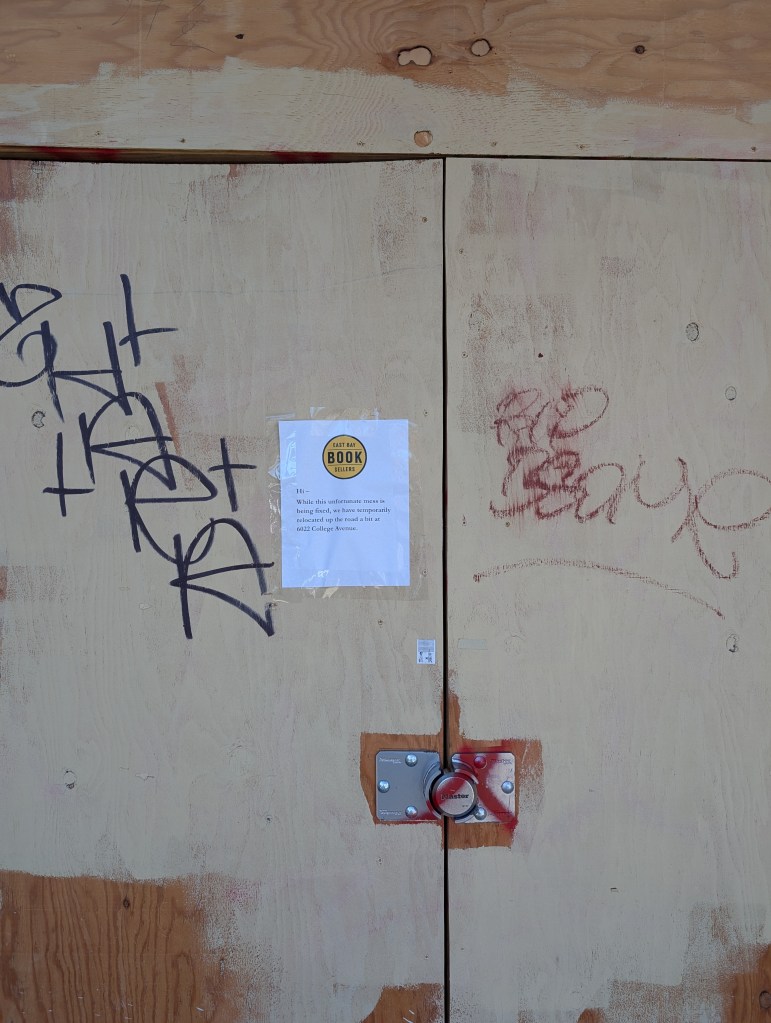
I used to go to Cactus Taqueria on my lunch breaks when I worked at East Bay Booksellers, where I sold a lot of Yuri Herrera’s novels, and when I stopped working there I stopped coming here to order the same thing every time—a veggie burrito, mejor, with black beans. Back then, before the pandemic, they had a great salsa bar, that I would usually procure too much salsa from. That burrito is still great, but the salsa bar, alas, is no more. East Bay Booksellers burned down earlier this year, but over the weekend, reopened in a new, temporary permanent location. And though I have been a little salty that Season of the Swamp is out in a hardback that costs more than the “Three Novels” collection of his first three novels—and I object to “slim volumes” being published in hardback just on aesthetic grounds—the re-opening of EBB gave me warrant to spend a little extra money.
Across the street from EBB, I ran into Pete, who runs music at the church there, that I picked a few tunes with, once upon a time. I took off my headphones, that I was listening to Spanish sentences in hands-free mode on Clozemaster. He told me he was glad to see EBB re-opened. When they re-opened, he said, he brought them flowers.
Discover more from and other shells I put in an orange
Subscribe to get the latest posts sent to your email.
 and other shells I put in an orange