The “bay area” produces a distinct kind of unknowledge about itself, and for multiple reasons. One reason is that our media is shit, a shadow of what it was a decade ago, when we would have complained about how bad it is. When we’re not watching media produced in LA, we read things published in New York on devices, made here, that don’t want us to read at all.
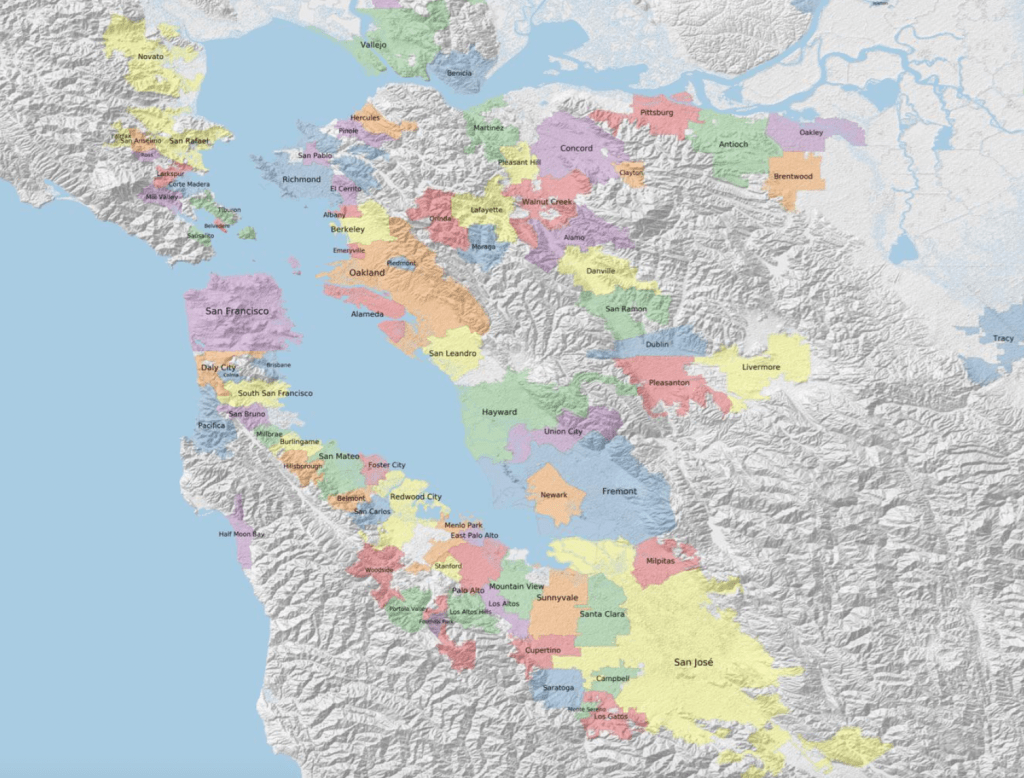
Another reason is that every part of the bay area has its own distinct refraction of this unknowledge: to live in Oakland or San Francisco—cities that think they are centers and self-sufficient entities—is to unsee the whole in which they are embedded, to be pulled by the gravity of Silicon Valley without even knowing it. San Jose doesn’t exist. And if you live in Walnut Creek or Fremont or San Mateo—or any of the dozens of little towns that have names, but if someone asked what they were like, what would you say?—you’ll unsee and unknow the whole because you don’t even think you’re a part of it. Whether a suburb or a sacrifice zone, you’re in the “area,” but you’re outside of it, or it’s outside of you.
Another problem is that this place—which despite itself, really is one place—is oriented around an emptiness, the bay. Even the name denies that it is a city; merely an area, you can never get closer to it than that, to be in the area. No one knows how far it extends. (Are the hills part of the bay area? San Jose? The Diablo suburbs? Pacifica? Santa Cruz? Santa Rosa? Sacramento?) But more than an emptiness, it’s an obstruction. The bay is a wall that keeps us all apart, all the more when the actual coast is guarded by freeways or railroads. So, too, with the freeways that connect the bay together, to the extent that anything does: closed-off highways of closed-off vehicles in a death bound race to get away from where they are as fast as possible. Where there are trains, you don’t want to be on them—you are told, and maybe convinced of it—and the buses that everyone takes, well, no one rides the bus.
And then there’s the fact that if you’re from here, you’re more and more likely to have been priced out and moved away some time ago; if you live here now, you can date yourself by saying when you’ve arrived, a number which will explain exactly how foreign you are to the place you live. A tech economy built on placeless displacement produces a place which is filled with people that aren’t from there, as alienated as their labor. And then if we live on our computers, on the internet, working from home, and we’re never at home except when we’re at work…
Discover more from and other shells I put in an orange
Subscribe to get the latest posts sent to your email.
 and other shells I put in an orange