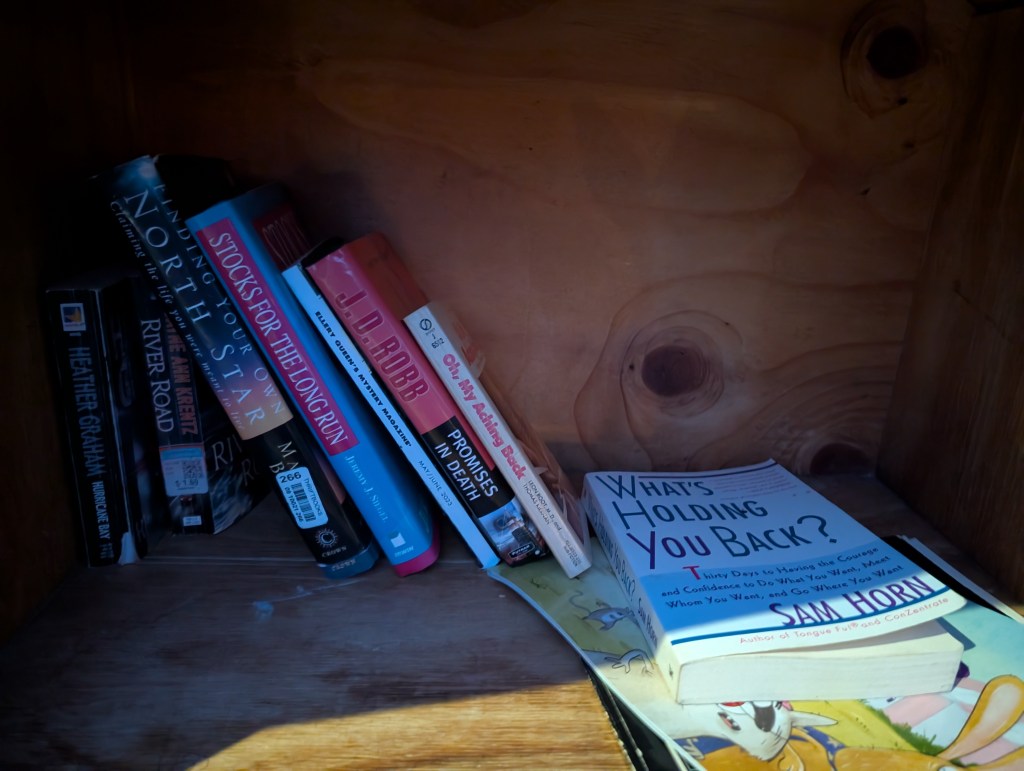
Obviously, as we search for our first clue to the meaning of this Little Free Library’s interior, the first thing we notice is the repetition between “What’s holding you back?” and “Oh, my aching back.”
You could spend a long minute thinking about that, about how a back does support you and how, yet, when we can’t do something—because of a bad back—it’s the back that’s the problem, the thing that’s preventing us. A lack of support is opposition, we think, because we are fools. We want to think that the problem is external, that there’s something out there holding, pushing us down, and preventing us from doing the thing, whatever it is; yet, at the end, what we’re really saying is that that external thing isn’t helping us achieve our goals, and that the absence of help is hindrance. And to twist the knife even more, it isn’t even external.
The problem, of course, is time. Why wouldn’t your spine get a bit worn out, the lettering hard to read, if it was published in 1966? And yet, here this book still is, ten years since its first author passed—who was a “devoted husband, father, grandfather, orthopedic surgeon and role model to many”—and twenty-three since its second, who would become a serial biographer, and “a personal acquaintance and occasional tennis partner of Rupert Murdoch, the subject of his biography, Citizen Murdoch.” Here the book still is, fifty nine years later.
The much more gently read Sam Horn promises that “You never again need feel powerless in the face of uncertainty, awkward with strangers, or helpless in new situations.” Published in 2000, so it’s easy for her to say such things: History had still ended, back then, and they weren’t making more time, or at least not much of it. Sam Horn is “the Intrigue Expert, helps people create one-of-a-kind presentations, pitches, brands, and books that scale their income, impact, and influence—for good.” She is the sort of person who does not have back pain, or die. When she does things for good, they stay that way forever.
And yet the author of Stocks for the Long Run, Jeremy Siegal, reminds us that back pain is what keeps you from running, that something is holding you back. Siegal was criticized for using a perspective “too long to be applicable to today’s long-term investors,” and his 1994 book did not see the crash coming. Few do, do they?
So I think it’s clear: the story this LFL is trying to tell us is about time, and about mortality, about how the current carries us forward—the road, you see, is a river; the bay is a hurricane, and yet also a bay—and we think it’s our own strength, choices, and will, only to find that the endpoint, the destination, is just the undoing of all that brought us there, the tide coming back in. Identity is an illusion, the lie our ego tells us when we think we are individuals, or when we think time moves forward. The cyclical time of hurricanes and the permanent calm of bays; the ceaseless flow of rivers, moving endlessly forward and never changing.
After that, the rest of these books basically fall into place. JD Robb, for example, is, of course, really Nora Roberts (who of course is really Elanor Marie Robertson) was 44 when she starter the “…in death” series, in 1994, at a time when the year this mass market cop romance sci-fi is set—2058—still seemed pretty far off (especially because 1994 was maybe the year when history really hadn’t stopped being over the most). But thirty-one years and over fifty books later, we find ourselves only thirty-three years from that date. Will Elanor Marie reach it and age 110, one wonders? Or does death still keep its promises?
It’s a lot, it’s all just a lot: such are the morbid thoughts one finds oneself locked into, the more you try to claim the life “you were meant to live,” and which yet eludes you. There’s too much of it, and it keeps coming. Who could have anticipated that the longer you live, the older you get? Certainly not Elanor Robertson starting a trilogy in 1994 and discovering, one day, that she had written fifty books. The same with life coaches like Martha Beck (who “created Wayfinder Life Coach Training, a powerful and highly effective way to master the skills of Wayfinding: navigating toward happiness and success in your own life while learning to coach others to do the same”). They have found the secret, and can teach you the secret, and yet they just keep writing books, they just keep pushing out more content, they just keep going: more crime, more stories, more catharsis, more crime…
Discover more from and other shells I put in an orange
Subscribe to get the latest posts sent to your email.
 and other shells I put in an orange