It took me a minute to make sense out of what I was seeing, a few weeks ago, because context was getting in the way. I was singing a chilean song to my toddlers in the back seat, and thinking about the park I was taking them to, and the way to get there and all the traffic on the road: all that stuff of life that prevents you from noticing things, or making sense of it when you notice it.
But my eyes had locked onto the numbers on the back of the car in front of me, for a long time, as if waiting patiently for my brain to understand why. And then I did: it was an Oakland police cruiser with the numbers 1488 clearly stenciled on the back. This is a number used to identify as a neo-Nazi. Like Elon Musk doing a sieg heil while talking about preserving civilization, you see it and your eyes understand it and then your brain says “Wait, is that really what I am seeing? Am I understanding that correctly?”
A moment later, belatedly, I took this picture:

It’s not a great picture, and it doesn’t quite show what it’s trying to show. As hard as you try to see the white-stenciled 1488 there, on the back left of the car, you’re more likely to notice all the colorful stuff around it, the graffiti on that building, the green edges of parking slip, and so on. It’s hard to take a picture while driving—one really shouldn’t, distraction is a killer—and anyway, it turns out that your eye can see the world a lot more clearly than a camera can, which is why I know that what the camera trying to show was actually there. It was there because I saw it: the number 1488 on the back of a police car.
Was it put there by a cop who wanted to signal that he was a neo-nazi? Was it put there by someone else who wanted to signal that cops are nazis?
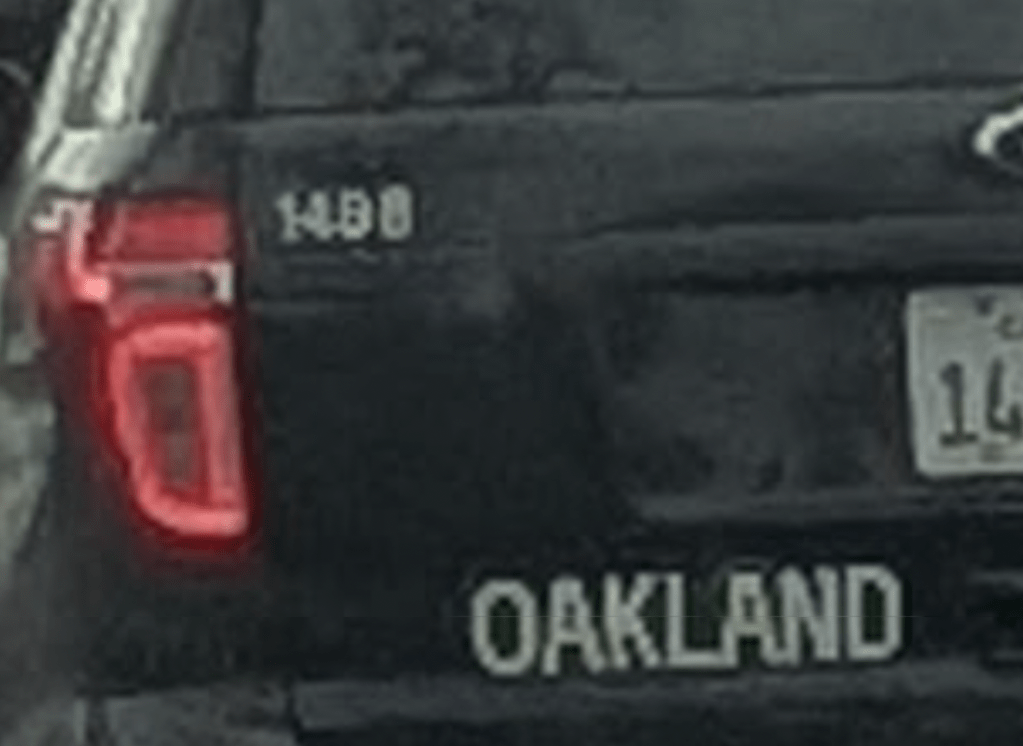
Fourteen is a useful number, and you probably use it fairly often in your day-to-day life, without ever considering whether it makes you a neo-nazi when you do so. Eighty-eight is less useful, more random, but “oh they were born in ‘88” is a thing you might say, for example, of someone like Steph Curry, who was, without meaning to use it as a numerological code for “Heil Hitler,” or taken to be doing so. 1488, however, is almost never a useful number, unless you want to tell someone the year that Bartolomeu Dias got to the Indian ocean, which is not something most of us need to do very often. It doesn’t seem very likely, to me, that this number would be stenciled on the back of that OPD Ford Interceptor as a reference to Bartolomeu Dias reaching the ocean.
What else could it mean? If you needed to tell someone where Oakland’s Mt Zion Spiritual Temple was located—for example, when it was the subject of a series of striking photographs in the early 2000s by the Chilean-born photographer Camilo Vergara, just before it burned down in a fire—you could use the following sequence of numbers: 1488 14th st. If you saw those numbers somewhere, on a tattoo or bumper sticker or graffiti or sign, you would know what they meant, just like—if you see someone doing a sieg heil, to a camera, twice, you not only know that it means “Heil Hitler” but you know that it means that the person who is doing it is saying “I am a neo-nazi.”

You probably don’t need to tell someone where Oakland’s Mt Zion Spiritual Temple was located very often, however. Unless you know someone at this address—say, whoever lives in this 2 bd, 1.5 ba, 1900 sqft apartment, built in 2015 and apparently sold in May—you probably won’t need to use this address. If you passed it on the street, though, the number might catch your eye. You might, as I did when I saw that cop car with the 1488 stenciled on the back, think, “wait a minute, what.” You might think to yourself—the way you do when you see Elon Musk doing a sieg heil at the inauguration of a far right, Nazi-curious president—did he just do that?
When David Eden Lane coined that numerological code for white supremacy, at some point in the nineties, this building in West Oakland had already been using that number as its address, at the intersection of 14th and Peralta, for close to eighty years. When it opened as The New Peralta Theatre in 1915, Adolph Hitler was still in his failed-artist-about-to-get-wounded-at-the-Somme era, and no one was a neo- of the movement he would eventually spearhead. It is therefore extremely unlikely that the New Peralta Theatre was located at this particular location as a preo-nazi code. That would not be a reasonable assumption to make.
It is interestingly possible that they showed The Birth of a Nation in the Peralta theater in 1915, however, the famously racist epic that would help inspire the rebirth of the KKK when it came out that year. It would be very unlikely to be screened in West Oakland today, of course, and if it did, everyone would know what it meant. If it was screened in West Oakland in 1915, however, maybe it wouldn’t mean as much, the Klan not yet having been properly re-born; maybe there, it would mostly still have just been a movie (which of course it is). It was eventually screened in the White House, however, where it meant that the president was a white supremacist, because he was.
There used to be a lot of white supremacists in Oakland. “The Klan had a substantial chapter in Oakland,” as Ali Winston and Darwin BondGraham write in The Riders Come Out at Night: Brutality, Corruption, and Cover-up in Oakland; “setting up a downtown storefront office in 1921 and hosting huge rallies at the Oakland Civic Auditorium by Lake Merritt.” In 1922, “the East Bay KKK’s members included perhaps as many as thirty Oakland police officers,” and “The Klan made a point of recruiting police officers…the “invisible empire,” as the KKK branded itself, set up terror cells initially by recruiting cops.”
Cops with ties to far-right extremist groups is less a thing of the past than one might, perhaps, imagine. Still, the “invisible” part of it seems important: putting a 1488 on your cruiser seems like it would strategically unwise for a police department which has—as Winston and BondGraham also extensively document—spent the last two decades under a court-ordered microscope as it has rather flagrantly failed to reform itself. I sent BondGraham a direct message, on bluesky (because twitter is owned by Elon Musk, and increasingly filled with neo-nazis as a result) and he opined that he couldn’t imagine an OPD officer thinking they could get away with that without being fired. I guess it depends on who that officer thinks his boss is.
West Oakland was not a Klan stronghold in 1915, of course. The town was overwhelmingly white—and remained 95 percent white as late as 1940—but the native-born protestants in the hills and East Oakland, who formed the bulk of its Klan members, tended to focus on the threat posed by the city’s working class and ethnic white communities who tended to be centered in West Oakland (while the cops focused their aggression on the Chinese).
After the forties, a great wave of Black migration began to reshape the city, and that was when King Louis H. Narcisse located his first church at 1488 14th St, in what had previously been the Peralta Theater. It seems very unlikely that he chose that location as a tribute to the freshly deceased fuhrer, or that it had anything to with what David Eden Lane would—fifty years later—coin as his 88 precepts (because of how time works). Another reason there is not likely to be a connection is that number 35 of David Eden Lane’s 88 precepts declares that “Homosexuality is a crime against Nature,” and King Louis H. Narcisse was apparently quite openly and unvexedly gay. There is no reason to suspect that anyone attending the Mount Zion Spiritual Temple ever did a double-take at the address, for example, the way I did when I saw that police cruiser with the number 1488 stenciled on the back, or the way we all did when we saw Elon Musk do a sieg heil at the presidential inauguration.
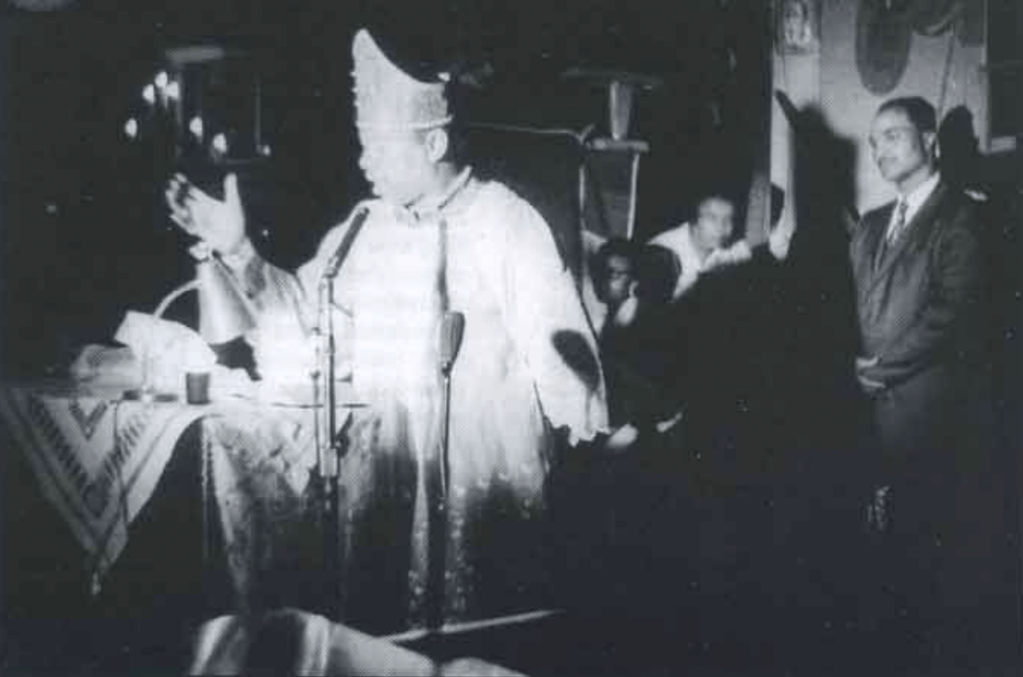
Narcisse was a real character. You can still listen to a lot of his music online (and scour the comments for a variety of personal memories of what that church meant for West Oaklanders of a certain age):


Narcisse’s credo “It’s nice to be nice” probably hung in the church he founded until it burned down in 2004. Narcisse died in 1989, a year after Steph Curry was born, the year the Oakland Athletics swept the Giants, in four games, in a World Series marred by the Loma Prieta earthquake. The earthquake would collapse the upper deck of the Cypress freeway, between 7th and 18th streets, killing 42 people in West Oakland.
When the Nimitz Interstate Highway had originally been built through West Oakland, in the late 1950s, the part of it that would collapse during the Loma Prieta—called the “Cypress Freeway”—had been built, rather intentionally, both to destroy and to bisect and isolate much of what had, during and after the war, become the heart of Oakland’s Black community. Since the Nimitz was built to connect southern Alameda County to downtown San Francisco—so that white people in the suburban East Bay could get to San Francisco without having to drive through West Oakland’s Black neighborhoods—it was only a perk of its construction that it rendered West Oakland less habitable for the black people that lived there, that, as a result, “a roughly four-square-mile area was cut off from downtown and more affluent sections of West Oakland to the east, sandwiched against metalworking shops, railyards, and the Port of Oakland. Over the years, neighborhood businesses withered from isolation, while residents were forced to endure the fumes and noise from the thousands of cars passing overhead.”

The city planners who did it were fully aware of what they were doing, of course. You can read the old planning documents. West Oakland was blighted, they believed, and when they used words like “urban renewal,” it was understood that this was code for “Negro removal.” They named it after Admiral Nimitz because he was a war hero: a white Texan whose grandfather had fought for the confederacy, who fought in WWII’s Pacific theater, expanding the United States’ imperial holdings there, and who, after the war, settled in San Francisco and joined the Bohemian Club, a male-only secret society that put on an “Early American Minstral Show” (sic) as late as 1998. As far as I can tell, he was not a Klu Klux Klan member, however.
When it collapsed in 1989, the “Cypress Freeway” section of the Nimitz freeway was re-routed closer to the port. It became “Mandela parkway,” a very pleasant split lane road with a greenway down the center. When Barbara Lee—then D-Oakland—met with Nelson Mandela in Washington DC, she reminded him of his namesake parkway and the newly completed landscaping: “He was very, very thrilled,” said Lee’s senior policy aide, Miguel Bustos. “She said his courage was similar to the courage of the people here (in West Oakland).” When Lee was a student, she volunteered at the Black Panther Party’s Community Learning Center and Bobby Seale’s 1973 campaign for mayor of Oakland. She recently announced her plans to run for Mayor of Oakland.
It’s not clear why the Mount Zion Spiritual Temple burned down in 2004. But one reason ATF agents “spent the day at the Mt. Zion Spiritual Temple investigating a Monday morning fire that gutted the church,” as an old East Bay Times article tells us, is that there had been a series of fires in black churches—one every five days from 1995-96—that prompted Bill Clinton to establish a justice department task force to investigate. The conclusion would be that while “the people burning down black churches in the South are generally white, male and young, usually economically marginalized or poorly educated, frequently drunk or high on drugs [and] often deeply driven by racism,” it hadn’t been “a national or regional conspiracy, according to investigators.” At most, “the conspiracy is racism itself.”
Coincidence can feel a lot like context, sometimes. When there was a rash of arson in deep-south black churches in the 2000s, a lot of people asked the same set of overdetermined questions: is it the Night Riders? Is it organized white supremacist violence? Is that the context? Or is just coincidence? We could ask the same question about the “Riders,” the four cops who brutalized West Oaklanders, the way their predecessors did a century earlier. Did they mean for the term to sound like Raiders? Or was it a wink to the KKK? Yesterday, on Martin Luther King Day, Elon Musk did a sieg heil at the inauguration of a white supremacist president, and there, too, coincidence can feel a lot like context.
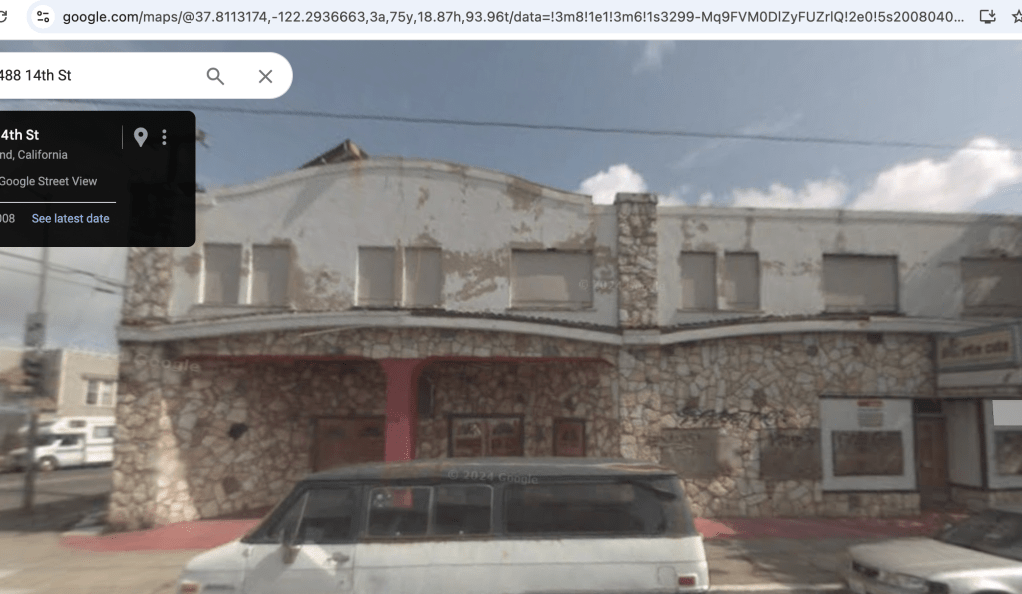
After the Mount Zion Spiritual Temple burned down, it was vacant and abandoned for some time; in the mid-2010s, on google maps, you can see if get renovated.


Reality is a lot duller than conspiracies, I guess, though that doesn’t make the substance of it any less white supremacist. In the weeks since I saw that OPD cop car with a neo-nazi number, I’ve more or less established to my satisfaction that the number doesn’t really mean anything, per se. I’ve seen a lot of OPD Ford Interceptors on the street, and I’ve noted that they each have a number, which is usually in that range. Here’s a #1466, for example. The more numbers I saw on OPD Ford Interceptors, the more it seemed like just a number. Then again: does that non-meaning meaning anything? We know what OPD is, and what it’s for, don’t we? And seeing Elon Musk do a sieg heil at a presidential inauguration only “reveals” what it does because we always already knew it was there, even if we sometimes allow ourselves to overlook it.
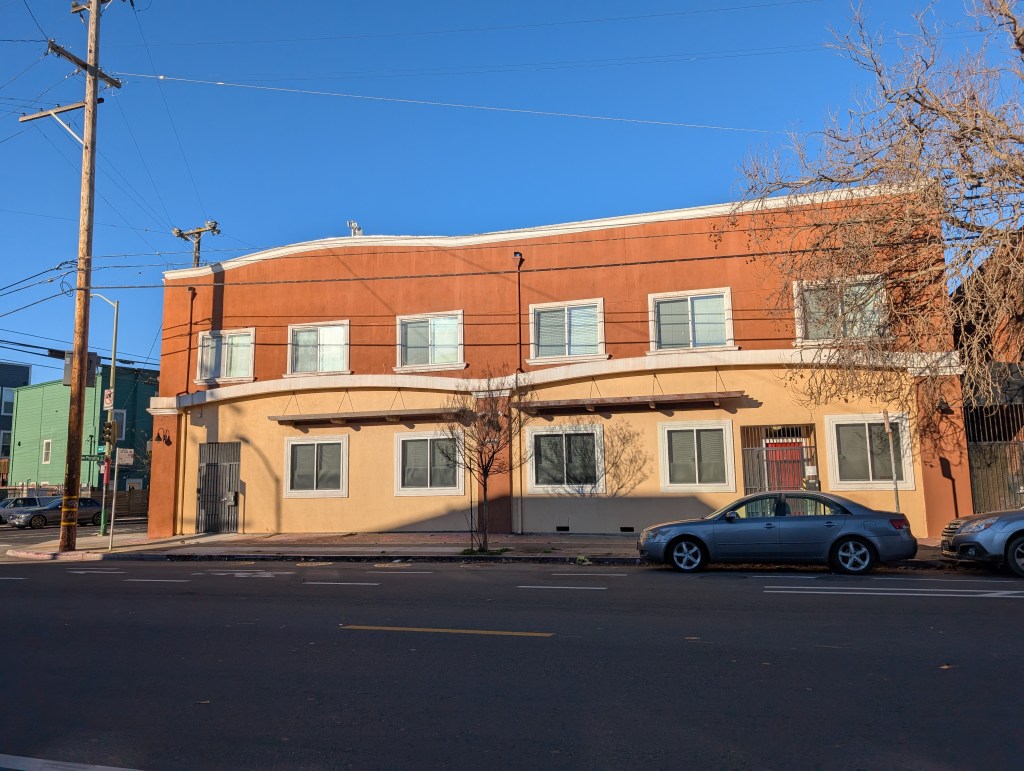
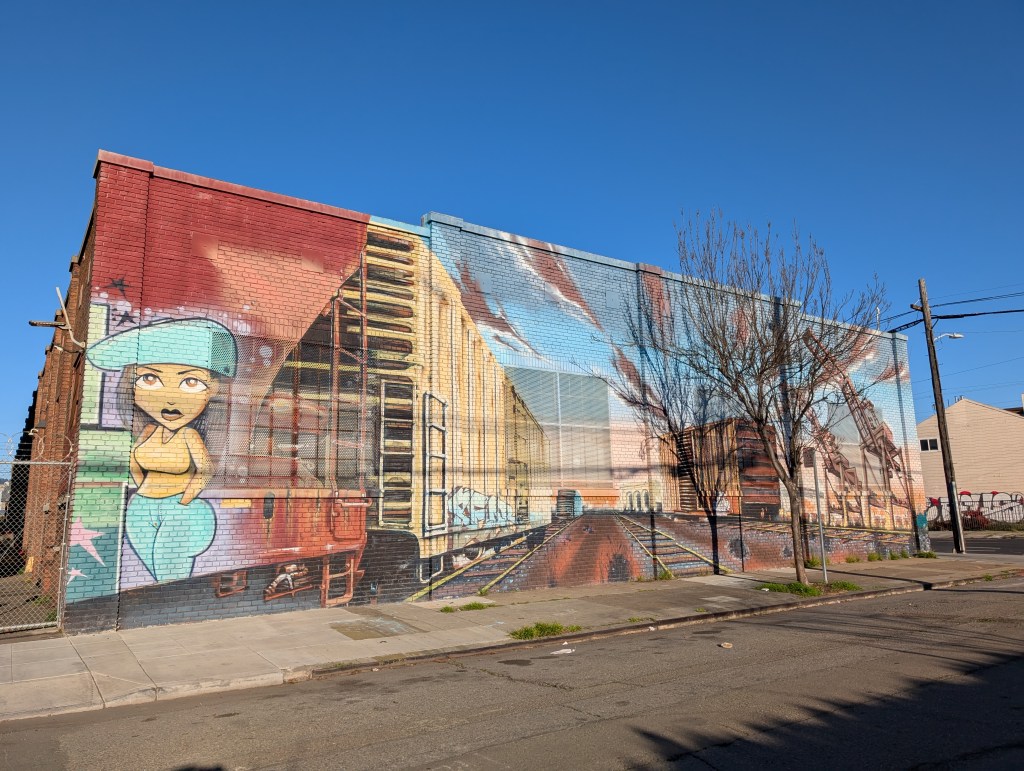
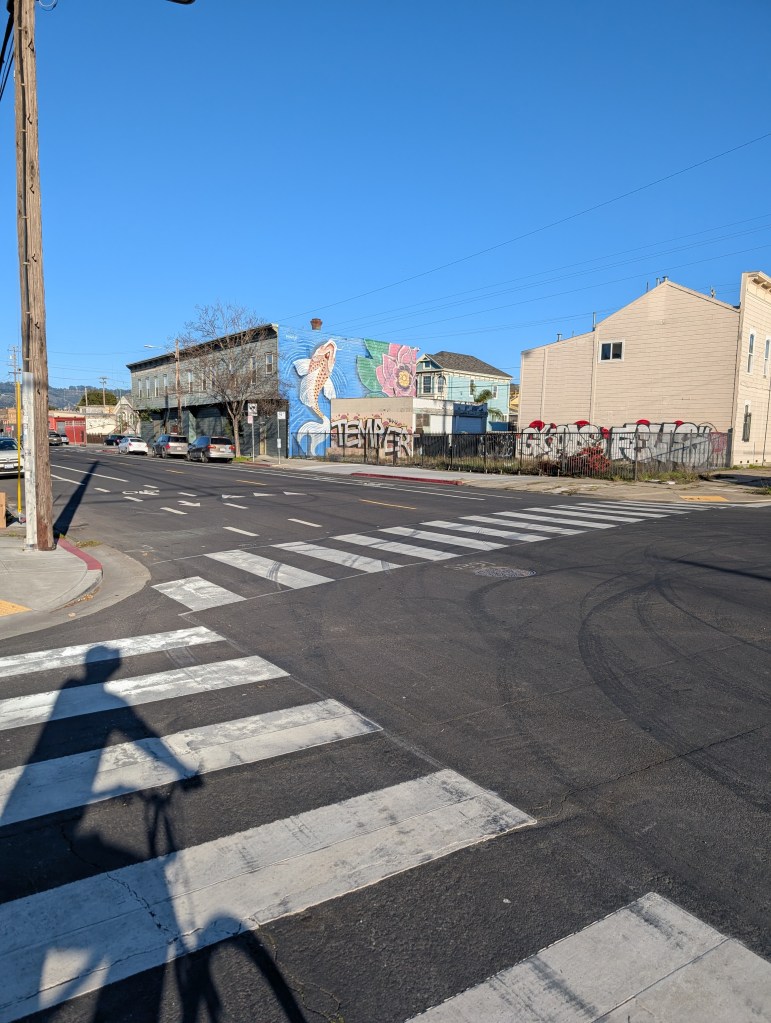
If you pass by 1488 14th Ave, as I did, on my bike, you’ll pass by one of the dullest looking buildings you’ve ever seen. You’ll pass by it because it’s so dull, so unremarkable, so beige, that your eye will barely even notice it’s there. The neighborhood is colorful, by contrast. It sounds like I’m talking about skin color when I say that, using the word as code. Maybe I am. Maybe I’m saying that because you will see a lot of Black people on the street, and they will see you, and if you are as beige as I am, they will note you, and you will note them noting you. But mainly I’m just saying it because how graffitied and painted and lavishly colored every other building around it is.


The white-walled interior of 1488 14th street, as I’ve gleaned from a variety of realtor images and videos, has the particular hard plastic smoothness, leavened by deep and glossy wood-browns, that I think of as a distinctly gentrification aesthetic, sort of Steve Jobs listening to smooth jazz, with lots of houseplants:
I suspect if you live here, if you are a white person, the dullness of the exterior is the same kind of erasure, a surface meant to be overlooked. That is the point of living here: to go inside, and there, not be seen from the street.
When realtors describe condos in the building, they never mention the Mount Zion Spiritual Temple; instead, thery say things like this
a loft in the historic Peralta Theater Lofts. Once home to the historic Peralta Theater, which harkens back to the day when West Oakland was a musical district, with night clubs and music venues. Now, re-purposed as a hip and cool loft building, the property was renovated in 2015.
This realtor also doesn’t mention that it was a Black church for most of its existence. Instead, he tells us all about how conveniently located it is to allow you to get downtown, or to get to San Francisco. He doesn’t say, as Mayor Jerry Brown once did, that Oakland is “closer to San Francisco than San Francisco is to itself,” but you get the point of it; this is a place to live if you are going to work elsewhere, if what you want out of an address is an absent context. This is a place to live, if what you want out of Oakland is walls enclosing a colorless space, erased of its people, a there with no there. You don’t need to be a neo-nazi to live here, in this living room, but it certainly doesn’t hurt.
Discover more from and other shells I put in an orange
Subscribe to get the latest posts sent to your email.
 and other shells I put in an orange