I’m not going to be fair to this novel, which I didn’t enjoy. I probably would have enjoyed it more if it hadn’t won the Booker Prize, though if it hadn’t won the Booker Prize, I wouldn’t have read it, and then—because I hadn’t read it—I wouldn’t have said “This won the Booker Prize?” But because Orbital by Samantha Harvey won the Booker Prize, I was annoyed by everything everyone had already said about it, when I read it (even though I wouldn’t have read it if they had not already said all those things about what a great Booker Prize-winning novel it is).
I would also probably have enjoyed this novel more if I hadn’t started reading it on Trump’s inauguration day. “I didn’t really want the book to be overtly political” Harvey has said, and it isn’t. The fuck were you thinking, Samantha Harvey, I shriek, writing a non-political book like this on Trump’s inauguration day?
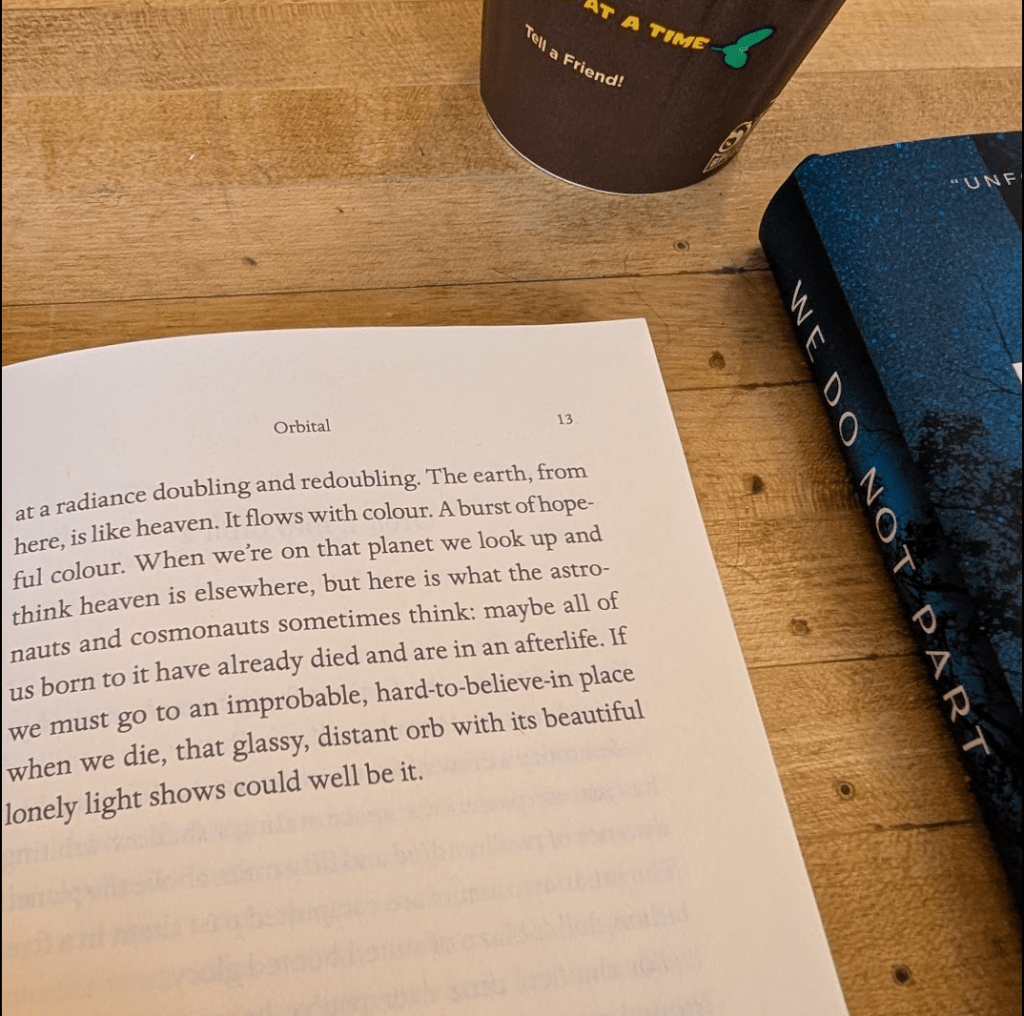
Mind you, had this book come out on some little press, and I discovered it on my own—on a day when fucking Donald Trump wasn’t being fucking inaugurated as president—I would probably have experienced it differently. Had I pulled it off the shelf of a used bookstore (huh, what’s this?), and enjoyed the first page (nice language), and kept reading (interesting conceit), and then googled the author (not much), bought it and kept reading (it really sustains the conceit), and did a twitter search (no one talking about it) and then I kept reading, and read most of it, even all of it, and then, yes: actually, a pretty decent little fictional prose poem about space, is what I might have told someone who was maybe just being polite when they asked if I read any good books recently.
“It’s sort of, ‘what if they did send a poet,’” I’d have told them.
Not all astronauts are Frank Borman, the astronaut who was hilariously bored with space, but still, you can’t help noticing how literary the collective consciousness of everyone in this book seems to be. The movie version would be mostly flashbacks and voiceover narration, and it would be directed by Terrence Malick at his most self-indulgent. Harvey’s astronauts spend their narrative time staring out the window, daydreaming about their lives and having deep thoughts about space, being humbled and awed by the majesty of it all. They are Luke Skywalker: never their mind on where they are, what they are doing. Harvey says she wanted to write about space “in a way that’s different to the way astronauts write about their time in space,” which concedes something, I think: what if we put the aesthetic reactions to space of a novelist into the minds of people who are not novelists? What if Astronauts, the book asks, were Samantha Harvey? What if the things she thought, as she wrote this book—with “footage of the Earth in low Earth orbit on my desktop all the time as I wrote…my main reference point”—were the things they thought?
They don’t tend to send novelists, though, and astronauts tend to be busy doing the enormously complicated work of running a space station. That’s why, if you flip through Samantha Cristoforetti’s Diary of an Apprentice Astronaut, you will find that most of it is about training to go to space, years and years of it. While Cristoforetti spent 199 days in space, which is a lot of days, she began training almost five years earlier. Orbital plunges you directly into an average day in space, with no preparation—straight from watching the preparations for Trump’s fucking goddamn inauguration to this—but when you look at Cristoforetti’s book, you find that more than twice as many pages of it are about preparing to go to space than actually being in space. I suspect this changes how she experienced space; it certainly changes how you experience what she writes. It makes sense that so much of her book is about the processes and devices and protocols and procedures of space, without the space: so much of her training was about making sure it all actually went smoothly, such that when she got to space—and this would seem to be a useful thing for an astronaut—her mind was so focused on all of those processes and devices and protocols and procedures, after years of intense training, that the “I’m in space!” of it all didn’t have a chance to (fatally) distract her from where she is, what she is doing.
I suspect that Cristoforetti wrote a book that actually is “the way astronauts write about their time in space”: much more hyper-focused on the details of doing astronaut stuff than Orbital is. There is less poetry. Cristoforetti does not say things like “Raw space is a panther, feral and primal; they dream it stalking through their quarters.” Cristoforetti says things like “As soon as I deflect the manual controllers, I find to my relief that the SSRMS is a well-domesticated beast: it moves tamely, following my commands, and is much more stable than the simulator arm, which accustomed me to managing much more significant oscillations.”
It’s a well-written book, and I didn’t finish it, because I’m not that interested in astronaut stuff. Orbital asks: what if Astronauts were not as interested in astronaut stuff as in philosophizing about Earth, below them? What if they spent most of their time daydreaming aesthetically? (The way Harvey does, at her desk, watching footage of the earth from space.)
The husband of one of the astronauts in Orbital tells her that “if he were ever to be where she is, he’d spend his whole time in tears, helpless in the face of the earth’s bare beauty.” The implication, and the nice tension of that scene—and it is a nice moment of interpersonal tension—is his assertion that she is not actually like that. And yet, she is; she’s just been lost in painterly reflection of how, “as they traverse south the colours change, the browns lighter, the palette less sombre, a range of greens from the dark of the mountainsides to the emerald of river plains to the teal of the sea. The rich purplish-green of the vast Nile Delta. Brown becomes peach becomes plum; Africa beneath them in its abstract batik. The Nile is a spillage of royal-blue ink.”
Everyone in this novel is like that, all constantly so overcome by the fact that they are in space that all they do is stare at earth and think things like that. It’s nice writing. If you like writing like that, you might like this novel. But to romanticize space like this, don’t you need a certain distance from it? Don’t you need to have “being in space” as an idea to contemplate, at arm’s length, like Samantha Harvey had when she was watching ISS footage of the earth? I feel like if you actually are in space, you’re going to be a little too taken up with the problem of your body in space to spend your whole time weeping at earth’s bare beauty.
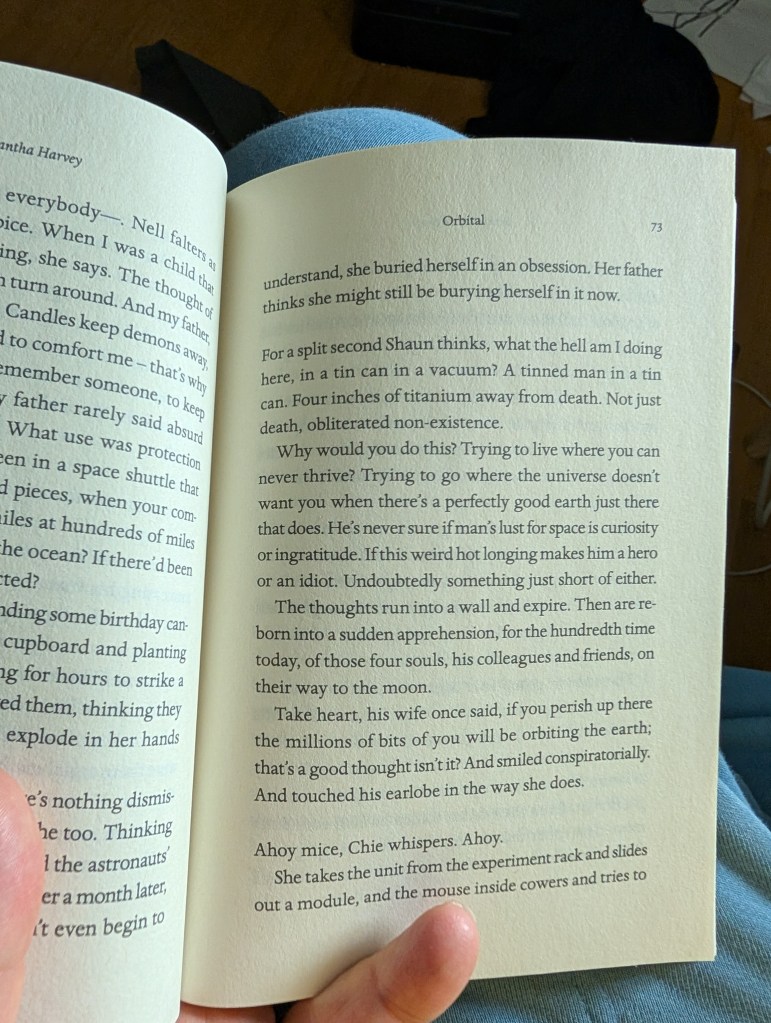
There’s something pansharpened about Orbital’s view of earth, in other words, in which two irreconcilably different modes of seeing have been forcibly reconciled, producing the view that should exist, in some sense, but probably couldn’t. Some measure of the book’s melancholy, I think, comes from this sense that space is wasted on people who go to space. The novel’s gambit is therefore to translate the experience into the kind of language, thoughts, and poetic prose that astronauts should be having and imagining.
(Am I wrong to find this incredibly annoying? Maybe! But I do.)
You may enjoy this novel a lot. A lot of people did. Had I been able to take this book as it is, somehow—not reading it with Trump’s fucking fascist ass in the background, but on some other hypothetical day when I could be objective and impartial and fair—I might have said, and been right to say, that it’s an artfully composed little book, precisely executed.
I might have said something like this: it’s the kind of realist fiction in which nothing much “happens” except consciousness—which is why there have been comparisons to Virginia Woolf, especially The Waves, although it’s actually not much like The Waves unless it’s been a while since you read The Waves and the main thing you remember is that it has the internal monologues of six people, which this novel also has, and also, the words on the page are not actually the kinds of thoughts people have, but more like a kind of novelistic extrusion of them, which this novel also has—but in that “nothing happening,” in the flow and movement of consciousness and perception, the narration is carried towards a kind of epiphany, narrative resolution by way of intellectual progress. A thought arises! A counter thought counters it! A synthetic thought merges and contextualizes and resolves the contrariness. It’s a book, in other words, in which a train of thought’s aesthetic power is that it appreciates a disordered and random cosmos into meaning; the sections nicely harmonize with each other, developing and meshing into a single, sufficient, artistic whole.
That can be nice to read. The problem is that I didn’t simply take the novel “as it is.” I read it, first of all, when I was thinking about how Trump is going to defund schools and send billionaires to Mars; I read it, second of all, because it had won the Booker, and when I opened it, the first thing I saw was six pages of PRAISE FOR ORBITAL and it all annoyed me a lot and I became very, very biased against this novel.
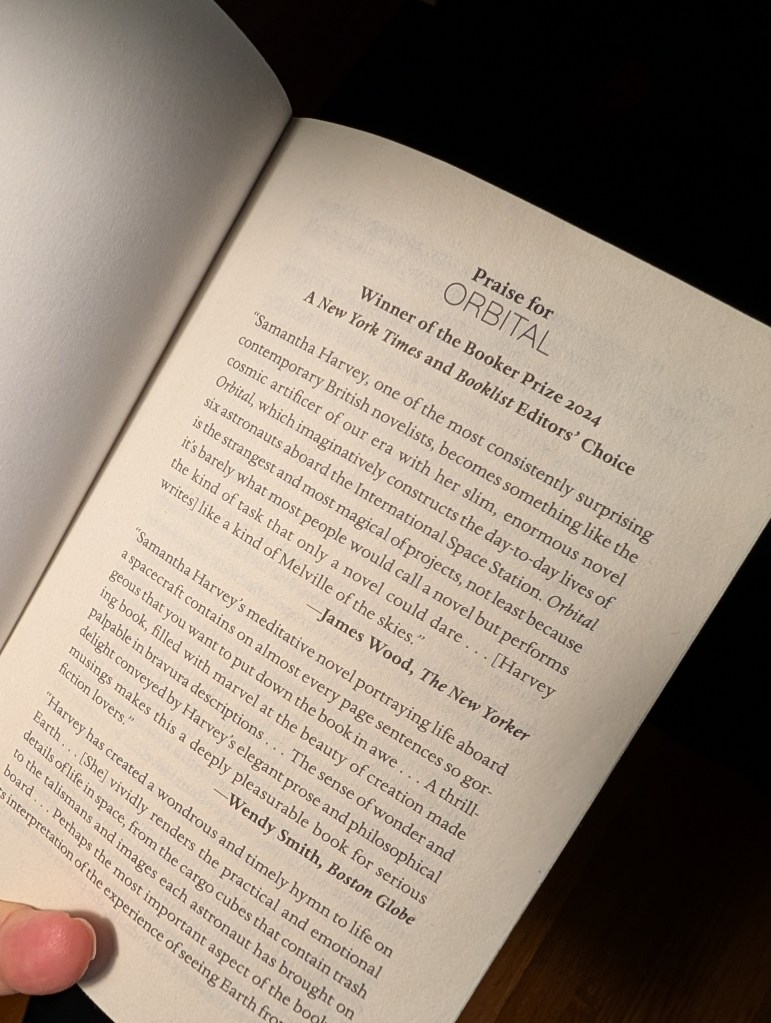
I found myself thinking about how James Wood’s New Yorker review opens with the reflection that “I can’t be the only traveller to gaze out of an airplane window, see the frothed clouds below, and reflect that this now routine astonishment was not offered to Blake, Melville, Tolstoy, Dickinson.” And he’s right that Orbital is a book about “how a writer might capture this spectacular strangeness [of Space] in language adequate to the spectacle.” But “Melville of the skies” is a terrible thing to saddle this book with! This book is not Moby Dick—or Typee, Melville’s exaggerated but basically autobiographical account of being stranded in Polynesia—to its great demerit; not because Samantha Harvey never went to space (lots of us haven’t) but because the book feels too obsessed with that lack (and in imaginatively correcting it) to actually do much with her theme. Moby Dick is not really about whaling, after all. Melville had stopped wanting to go to sea, and simply wanted to write books (and fuck Nathanial Hawthorne), but Orbital really is and wants to be about space. If Melville took the texture of real, lived experience—in all its fine-grained tedious facticity—and projected everything else onto it (but especially the United States of 1850), Harvey does whatever the reverse of that is: the grandeur of space become the occasion for putting all of the rest of that stuff into its place, making it small enough to dispense with words. A planet becomes a marble; all of human history becomes six seconds before midnight on new year’s eve.
In such a context, how could something as petty and small as Trump becoming president even matter? Wait one second and he will have been dead for thousands of years. In space, Trump is not even worth getting mad about.
But he is! The problem with space is that it is empty. It is the entire point of space that it is only filled with what you put in it. And you can fill it with poetry, sure, why not. But that’s something different than seeing the earth clearly, as it really is, because you’re so far away from it that it comes to resemble a painting. Things might look simple from space, but—as I was contemplating this book from Trump’s inauguration—there was a satisfied, melancholy consolation in that perspective that just annoyed the living shit out of me
Take this passage, a moment of transcendent vision as the astronauts gaze down on the petty squabbles and exploitations and violence of the world we’re born to live and die on; “Can humans not find peace with one another? With the earth?” they ask:
It’s not a fond wish but a fretful demand. Can we not stop tyrannising and destroying and ran-sacking and squandering this one thing on which our lives depend? Yet [the six astronauts in the novel Orbital] hear the news and they’ve lived their lives and their hope does not make them naive. So what do they do? What action to take? And what use are words?
It’s a good question! “[A] desire takes hold,” she writes, “to protect this huge yet tiny earth. This thing of such miraculous and bizarre loveliness. This thing that is, given the poor choice of alternatives, so unmistakably home. An unbounded place, a suspended jewel so shockingly bright.”
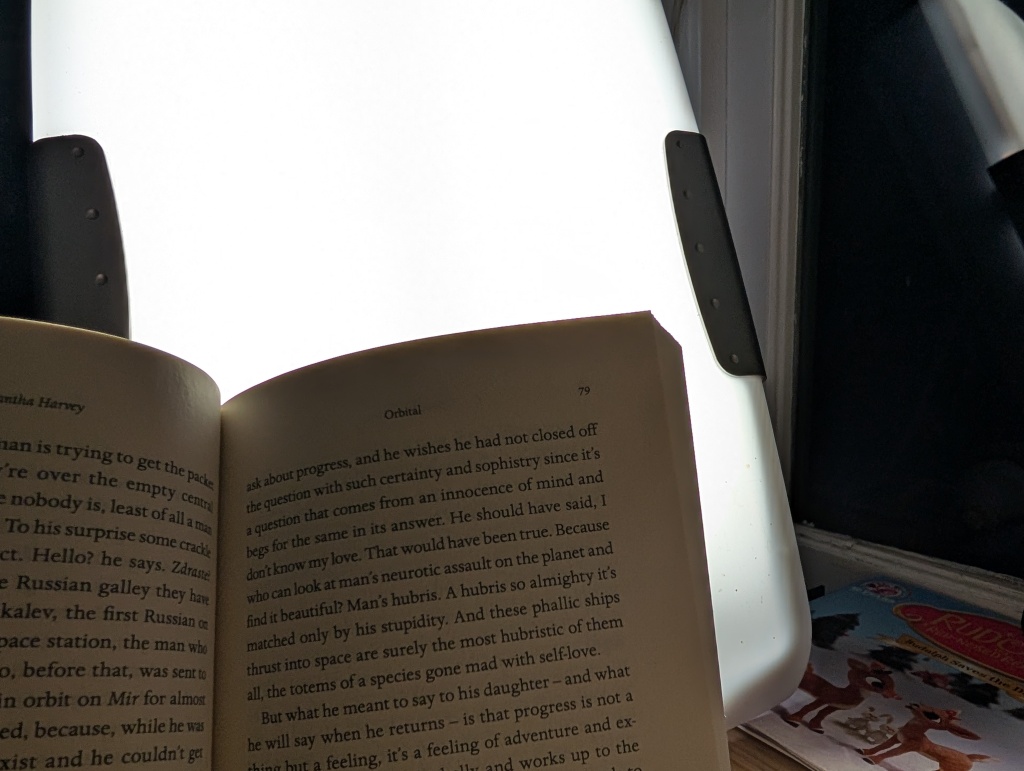
The blue marble fantasy is that if we can get away from earth, we can get away from all the (bad) things that make us what we are (bad); from space, you can look down and say things like “why can’t humans find peace?” as if it’s rhetorical, as the answer is easy (“just find peace!”). Harvey’s “humans with a godly view” respond to this vision, first, by not reading the news (“It seems easier on balance not to read the news”) and then by transcending it. For a while, they see politics as petty and small and pointless, and then, “one day something shifts”:
One day they look at the earth and they see the truth. If only politics really were a pantomime…The hand of politics is so visible from their vantage point that they don’t know how they could have missed it at first. It’s utterly manifest in every detail of the view, just as the sculpting force of gravity has made a sphere of the planet and pushed and pulled the tides which shape the coasts, so has politics sculpted and shaped and left evidence of itself everywhere. They come to see the politics of want…The planet is shaped by the sheer amazing force of human want, which has changed everything, the forests, the poles, the reservoirs, the glaciers, the rivers, the seas, the mountains, the coastlines, the skies, a planet contoured and landscaped by want.
Is this an insight? Is this transcendence? Or is this dorm-room philosophizing the kind of thing you tell yourself when you’ve decided you need to have an insight about all of human history and politics? “A planet contoured and landscaped by want” is not exactly untrue, but I’m not sure what you do with it. And equating want with gravity, as vast impersonal forces that can never be gotten rid of, well, it sort of feels like she’s starting with a blue marble fantasy of a borderless planet of human solidarity and saying “actually, no, the want of politics is as unavoidable, as inborn, as ‘the sculpting force of gravity.’” And the section ends, after implicating the astronauts themselves (“on their rocket whose boosters at lift-off burn the fuel of a million cars”) in the kind of mess that we’ve all made of our world.
It’s strangely thin consolation, actually. Is that the point? In one of my favorite sections, a voice on the radio, some nameless person from Vancouver, asks one of the astronauts if he ever feels “crestfallen.” This particular astronaut spends a lot of his on-the-page time chatting with random earthlings on his packet radio—a thing that they apparently do—because it allows for the kind of thing Harvey is interested in, moments where you can ask a naïve, earth-bound question like “Do you sometimes go to bed in space and think, why?”
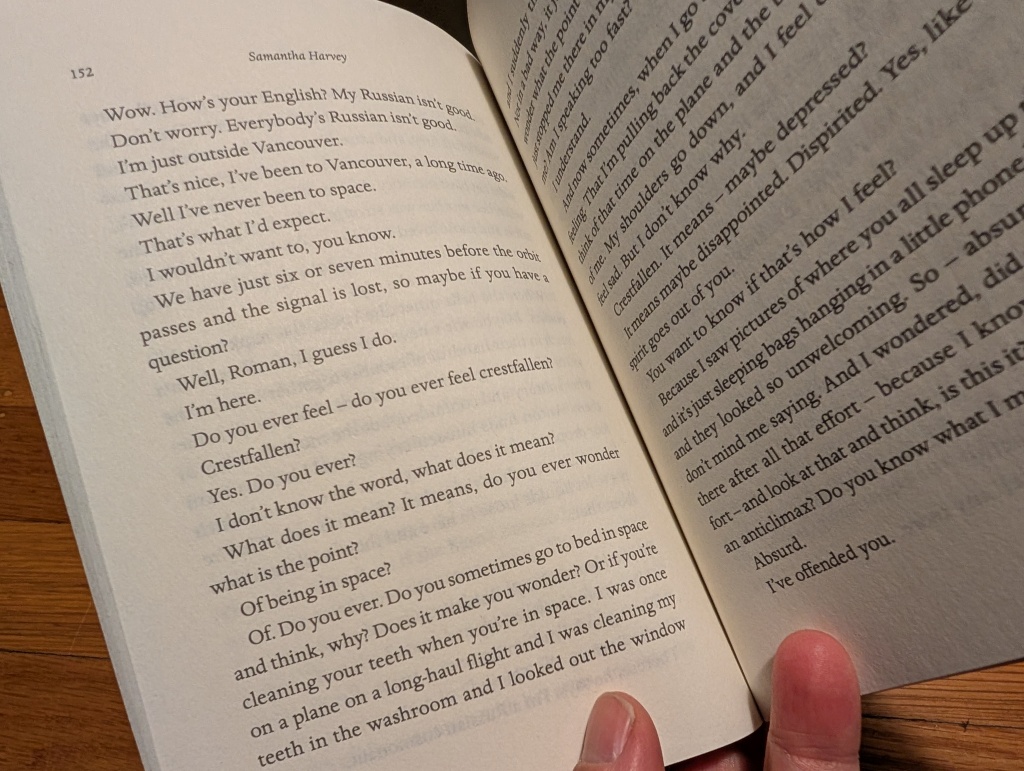
That question reflects how long it’s been since going to space was a shocking and novel event. Orbital is a book written long after space lost its capitalization, in the decades since humans have gone there and found out how little of Star Trek there turned out to be out there. And at its best, as this novel doesn’t go anywhere, as it just goes around and around—and as all of the things it is praised for innovatively not having (deep characters, plot, narrative movement) really turn out to be just things it doesn’t have, and you find yourself wishing, instead, that it actually did have them—I think you could read it as being about this discovery, that the problem with space is that it’s space (and that matter is actually a lot more interesting). The details of living in space don’t turn out to be all that interesting, actually; it’s a lot of checks and procedures and process. Your gaze turns back to earth, as you remember what actually matters.
But at its worst, at least for me, Orbital wants to insist that, in fact, not only is one not crestfallen in space, but that, through the kind of aesthetic alchemy of Harvey’s literary project, space can be made great again, and insistence on still being awed and humbled by the discovery of not being the center of the universe, that humanity’s entire span of existence is “more bomb than bud,” just a “fleeting bloom of life and knowing, one finger-snap of frantic being, and this is it.” We get a sublime experience out of it, when we watch a climate-accelerated typhoon slam into Asia, from space, and it becomes a pure and beautiful aesthetic experience. I find that hard to take.
“It’s not really a book about climate change,” she says; she was focused on a “visual idea, this painterly idea of what I was trying to portray.” And so, when she writes about a climate-accelerated typhoon, she isn’t writing about climate change or politics the way, say, the close-up and visceral imaginative terror of the opening of Kim Stanley Robinson’s The Ministry of the Future does, in which a lot of people die from a wet bulb event in Uttar Pradesh, lots and lots of them, like animals, like meat, and it’s fucking awful. In Oribal, climate change becomes beautiful, sublime, awesome. It becomes a thing you watch, from so far away; it becomes a thing whose awful close-up fury you have to imagine, and can paint.
I guess I just don’t like that. I don’t like when “space” is used as a warrant not to un-destroy the earth, when our destiny to colonize Mars allows us to forget how permanently tethered we are to the only planet we could ever live on, and how we are destroying its capacity to shelter us from the endless empty void outside. Harvey certainly doesn’t want to do that. But I think the conceit of this book is that space is a place you could live in; “Inhabiting space is a reality for humans,” she has said; “we have been continually inhabiting low-Earth orbit for 23 years now.” But we haven’t. People go into space, for brief blips of time short enough not to kill them, like scuba diving. And as beautiful as corals may be to visit, no human lives there. You would die there. You would simply die there.
And so, that’s why I’m annoyed when Harvey says she wants space to be a “wilderness” again, a final frontier. She said she wanted “to write about space without the projections that we usually put on it [because] so much sci-fi comes from the unknownness of space and our wish to project our fears and our hopes onto it.” When she says she “wanted to take all of that away and start with a blank canvas almost and simply see it as a natural environment that humans are inhabiting,” I want to tell her that this is a crazy thing to say. Space is the definitional opposite of a natural environment that humans are inhabiting. It is an empty space that will kill you in a couple of minutes.
When Samantha Cristoforetti writes that she brought a Star Trek: Voyager uniform with her to space, she was talking about a show she loved, built on the fantasy that humans could live in space. Yet it isn’t that part of it that she finds herself dwelling on. After recalling how meaningful it was to her, as a seventeen year old when the show premiered, that both “the Voyager command bridge and its machine room were led by women” she finds herself expressing what I’ve always thought was the real message of the show, at its best: not that space would be a good place to live, but that making Earth a good place to live should be thing within our power, if we cared to give it a shot. And so she writes this, a simple “want” that I find myself clinging to, in ways that Harvey’s much more beautiful writing seems to wind away from:
I feel it would be a good thing for us to start recognizing again the role fortune plays in human events; to regard the successful with tempered admiration; and with equal admiration those who pursue their dreams with dignity and effort. Even when circumstances aren’t favourable, their effort is noteworthy and bears fruit. People who are motivated to give their best every day and to choose the road less travelled in the knowledge that it offers greater opportunities for growth are more likely to enjoy a fulfilling life, even if the dream that spurred them on is never realized. I wish every child in the world could grow up without knowing danger, violence, trauma or poverty. And then, I wish that all of them could have a dream to cherish.
And I find myself remembering that Voyager was, above all, a show about people who lived in space, but wanting to find the straightest and most direct way home.
Discover more from and other shells I put in an orange
Subscribe to get the latest posts sent to your email.
 and other shells I put in an orange