There are playgrounds that feel managed, that give you the sense that someone in a uniform might sometimes swing by, that there’s a committee, a fund, or a person with a salary and maybe even a desk. There are playgrounds that should probably be a particular way, one feels, and if they aren’t, if something is out of place, there is a “someone else” who is supposed to step in. It’s the sort of place where you can call the manager, even if (more likely) you can’t. You feel, in some way, that your tax dollars probably give you that right. You feel that they should, even if they don’t.
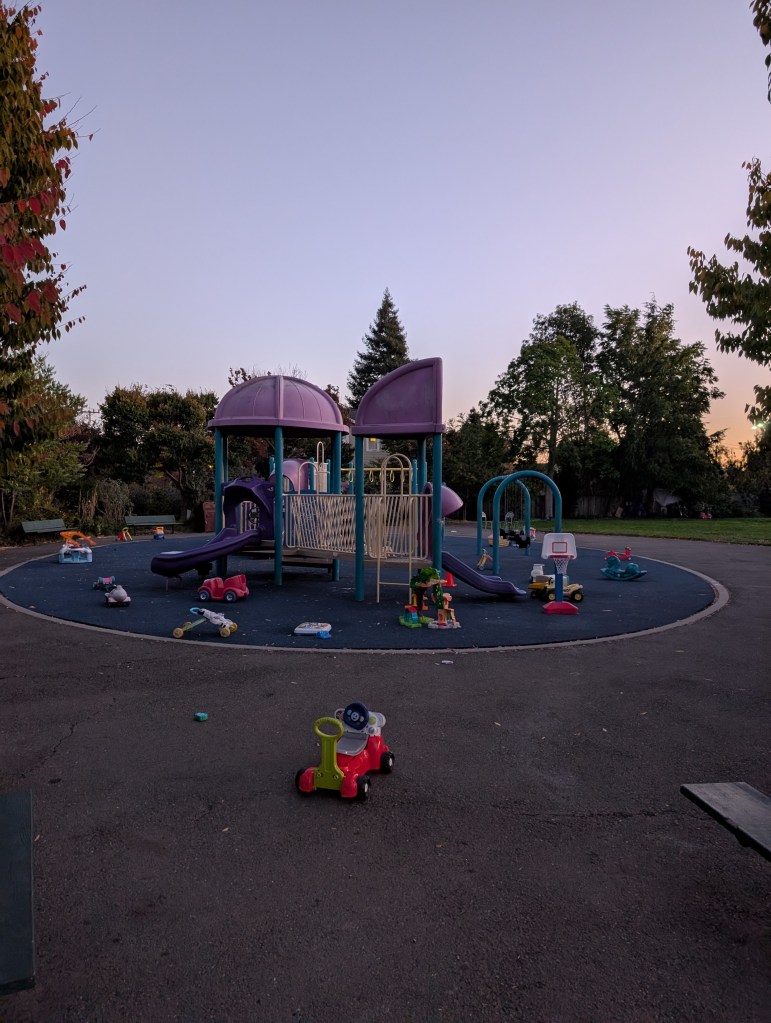
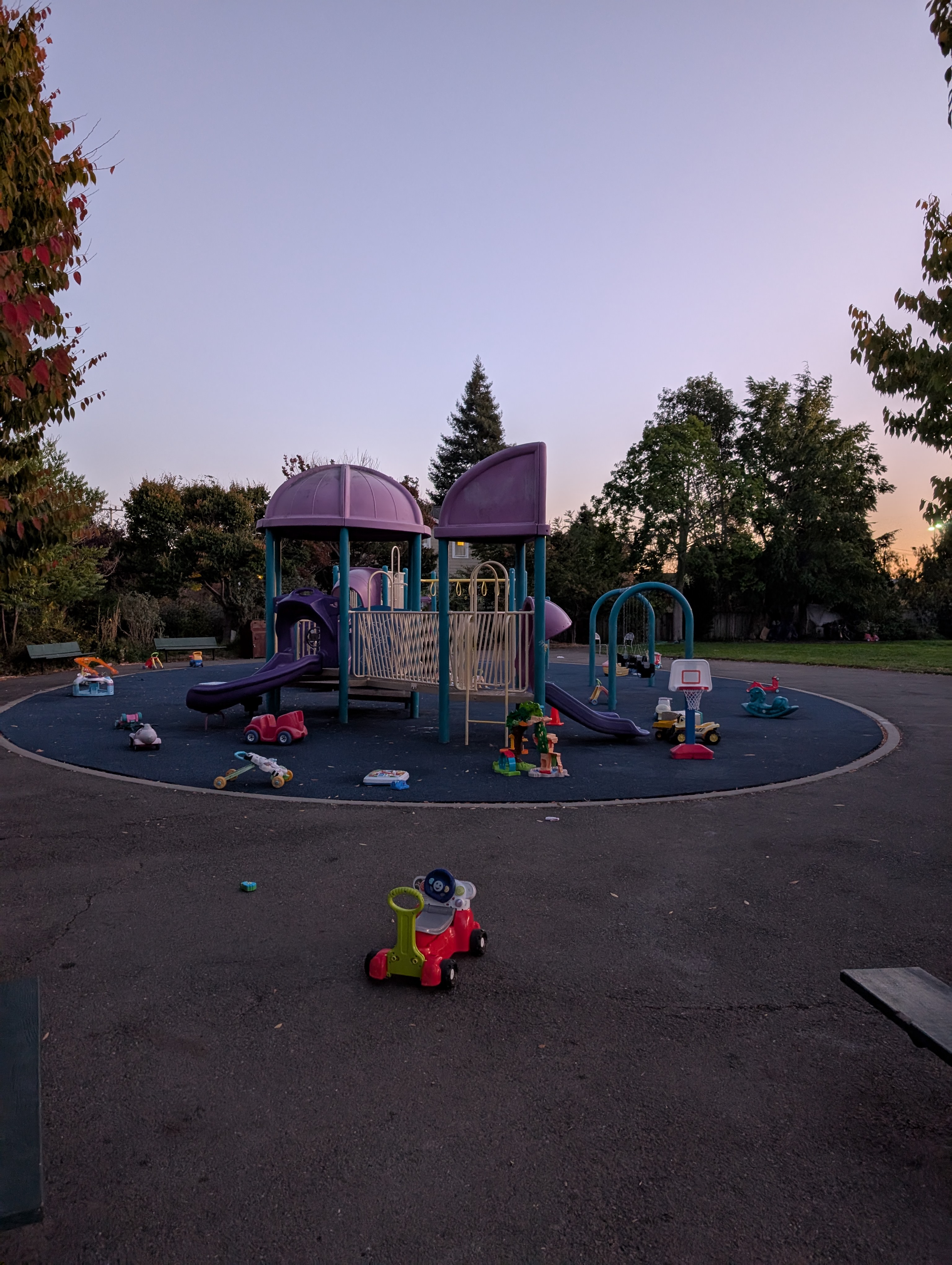
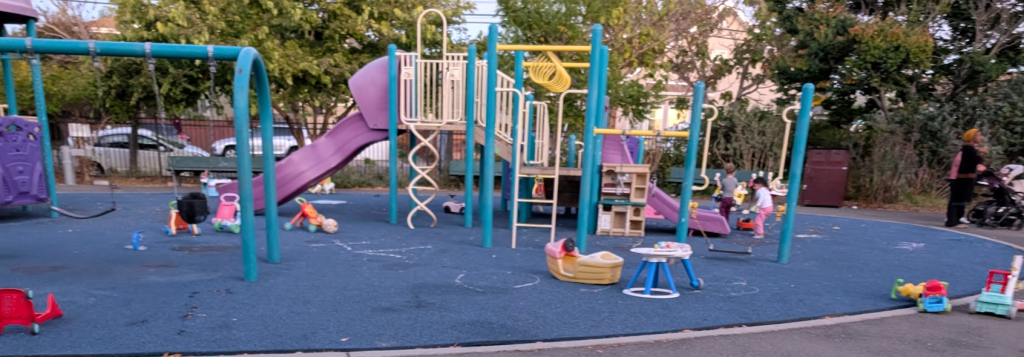
Dover Street Park doesn’t feel that way at all. There are holes in the rubber turf, the equipment is worn, and there’s a cluttery disorganization to the “the community toys and bikes left everywhere, seemingly dropped in mid-thought before chasing a butterfly or returning home for nap time,” as the Oakland Parks Foundation rather sweetly puts it. But one notices a strangely sterile emptiness to the photos they include of the park. It’s not just that there aren’t kids; there are usually no children in photos of playgrounds, for perhaps obvious reasons (mine is no exception). But the first things you see when you first see Dover park are very strikingly absent: There are few toys in this photo, everywhere you look—tricycles, plastic carts and cars, jumperoos, everything and anything you can think of, all being played with vigorously by very happy kids—and toddler graffiti, the drawings on the ground that little kids armed with chalk have made. You also don’t see the little encampment, tucked away on the opposite side of the park, working as hard as they can to be as little seen as possible.
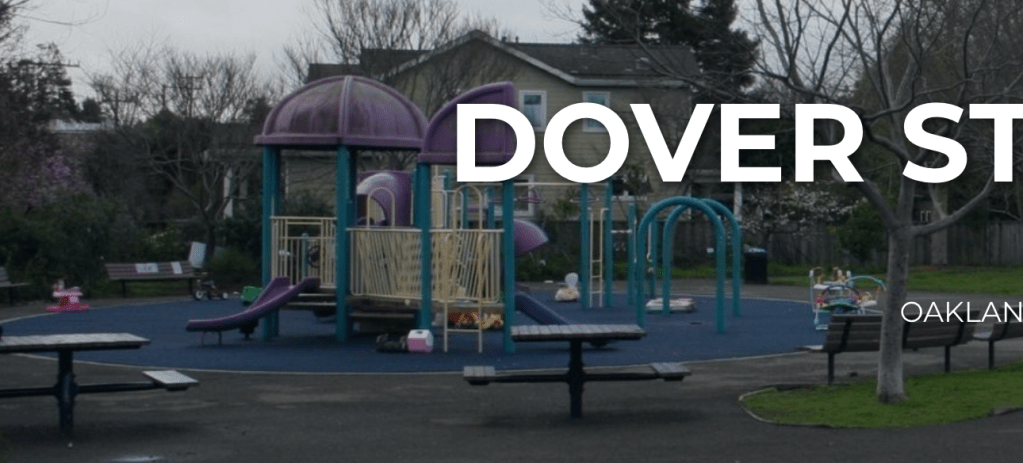
These absent things are a bit of a rorschach test. My kids love this park because they love the former and because they do not notice the latter. It’s among adults that you’ll hear phrases like “oh, I went there once, but there are so many homeless,” as I have, making conversation at other playgrounds, about playgrounds. I suspect that’s why these things are absent from that photo, because of how the adult eye—attuned to how spaces are managed, or aren’t—will so instantly be drawn to them, first and foremost to the edges of the lawn, to the sight of tarps, chairs, and tents. However muted and restrained, it leaps out at you, that matter out of place in the particular way an unhoused person’s home tends to be. There are not, to be clear “so many homeless,” but more-than-none can seem like a lot.
A child’s eye, by contrast, will be drawn to the true “so many” of this park, which is the wealth of bikes and plastic carts, boats and trains and long-broken musical toys—yet still capable of having fun wrung out of them—and so many different things that were loved, outgrown, and now donated to be loved again. They are everywhere except for in official photographs. You don’t know who brought them, but their plentiful abundance—and how broken so many of them are—can make it feel like it might not be anyone’s job to remove them. They might feel dumped, like trash. Your kids will disabuse you of this feeling, as they rush from toy to toy: that pedals are broken off, that nothing electronic still works, that there is outdoor dirt on indoor toys, or the way so many parts and latches and doodads have been ripped apart, none of the will matter to them. Each of these toys is a labyrinth of novelty, ripe and dripping with potential that they can explore (that has been evacuated from toys that are old to them, even if they still look “new”).
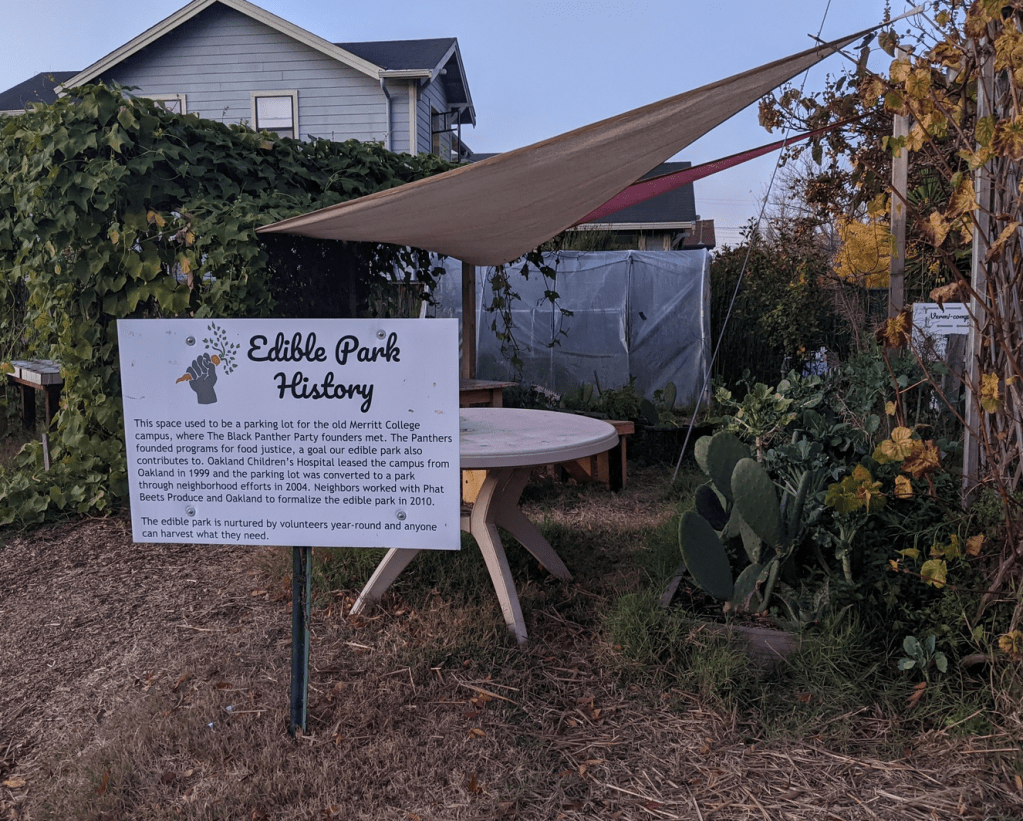
This park, by the way, occupies space that was once a parking lot for Merritt College, one of Oakland’s many theres that aren’t really there anymore. “What happens when black militants gain the upper hand on a college campus?” as the Wall Street Journal asked, in 1969, of the community college that once stood here; here, as Rasheed Al-Shabazz relates, “Student s at Oakland, California’s Merritt College successfully agitated to establish the nation’s first Black Studies Department in 1969 and hire the first Black college president in the state of California, Dr. Norvel Smith, a year earlier.” Huey Newton and Bobby Seale were alumni, and this piece of ground is where they met. You’re a block from “It’s All Good Bakery,” once the first headquarters of the Black Panthers. In the 70s, the college had been moved into the Oakland hills—with all the white flight spatial geographical warfare that implies—and the empty “physical plant” would be used as the shooting location for a forgotten Jim Belushi movie, playing the role of “drug infested high school.” It was eventually taken over by the nearby children’s hospital.
A remnant of all of that—or, perhaps, a survival—is Dover Edible Park, on the north side of the park, “an awesome food forest with a playground and huge lawn for playing and lounging about [where] volunteer gardeners work year-round to grow fruits and veggies that are available to all as needed.” They have a portapotty, a patreon to maintain it, and, henceforth, a few bucks of mine each month. You won’t see anyone in uniform, and there are no desks or salaries. But food is grown here, and people eat it. There is compost. Things that are thrown away live and are loved.
Discover more from and other shells I put in an orange
Subscribe to get the latest posts sent to your email.

